
Federal Support for English Learners Q&A
Understanding the U.S. Department of Education’s Role in Supporting English Learners through Title III and Other Provisions
How do the Trump Administration’s actions and policies affect students learning English?
The Trump Administration, through various executive orders and policy decisions, has expressed its broad intention to limit federal resources for students learning English, while also specifically targeting undocumented immigrants. Through executive order, the administration has attempted to: limit undocumented immigrants’ access to public benefits, including Head Start; designate English as the official language of the United States; and dismantle the federal Department of Education, the agency that oversees numerous programs that support English learners in public schools. The administration has requested the elimination of $890 billion for English Language Acquisition (Title III) funding that is used by states and local educational agencies (LEAs) to improve and enhance language instruction and support services for students learning English. It has also rescinded Obama-era guidance interpreting federal laws and requirements for supporting English learners. These actions create a climate that devalues multilingualism and encourages states and LEAs to reduce services for English learners and their families while still complying with legal obligations.
More Detail
Below is a chronological summary of the executive orders and other actions taken by the Trump Administration that directly affect English learners:
Executive Order “Ending Taxpayer Subsidization of Open Borders”
On February 19, 2025, President Trump issued an executive order calling for federal agencies to reinforce the 1996 Personal Responsibility and Work Opportunity Reconciliation Act (PRWORA) by restricting undocumented immigrants’ access to public benefits. While undocumented families’ ability to access public schooling is not (yet) being challenged (see below), an updated Health and Human Services (HHS) policy includes Head Start – a federally funded early childhood education program for low-income families – on a list of programs that will no longer be exempt from the PRWORA’s eligibility criteria.
Executive Order “Designating English as the Official Language of the United States”
On March 1, 2025, President Trump issued an executive order designating English as the official language of the United States, despite not having the authority to do so, and in April rescinded Department of Justice (DOJ) Limited English Proficiency (LEP) guidance from 2002. A subsequent memo from Attorney General Pam Bondi provided new interim guidance and directed federal agencies to reduce the provision of information to people with LEP. In August, the Trump Administration rescinded joint guidance from DOJ and the Education Department directing schools to accommodate English learners. The guidance does not change obligations under civil rights law, including laws that relate to a public school’s obligation to support English language acquisition. However, the executive order and rescinded guidance suggest that the administration may stop enforcing the law. Experts have cautioned that this could affect translation and interpretation services for students and families and might lead to a shift away from dual-language instruction and multilingualism and towards English-only instruction, despite mounting evidence that the former is more effective.
Executive Order “Improving Education Outcomes by Empowering Parents, States, and Communities”
On March 20, 2025, President Trump issued an executive order directing the Secretary of Education to facilitate the closure of the U.S. Department of Education and return authority over education to states and local communities. As will be discussed in greater detail below, students learning English benefit greatly from programs, services, and research projects that are funded and overseen by the Education Department. Even before this executive order was issued, the Education Department initiated a reduction in force that cut its staff in half. Nearly all the staff members in the Office of English Acquisition were laid off. Staff at the Institute for Education Sciences (IES) was reduced by 90%, and $881 million in education research grants was cancelled. By June, facing pressure from multiple lawsuits, Secretary McMahon rehired a small fraction of laid-off workers (74 of approximately 2,000) and revived about a fifth of the terminated research and statistics contracts. However, the Education Department’s commitment to those projects, beyond compliance with congressional statutes, is unclear.
Trump Administration’s FY26 Budget Request
On May 2, 2025, the Trump Administration released its FY26 budget request, including numerous policy and funding changes that will affect English learners. Most directly, the budget eliminates $890 million in funding for English learners arguing “the misnamed English Language Acquisition program…actually deemphasizes English primacy by funding NGOs and States to encourage bilingualism.”
Impoundment of Education Funding for FY25
On June 30, 2025, the Education Department informed state education agencies that it was withholding nearly $6.8 billion in federal funding for schools. States and districts expected to receive these funds — allocated through Congress’s continuing resolution to provide funding through the end of fiscal year 2025 — on June 1. Instead, the Department informed states that it was conducting a review and would not issue funds until that was completed. The “impoundment” affected five program areas, including $890 million for English Language Acquisition (Title III-A). By July 28, funds for all programs were released with little explanation.
What rights do English learners have under federal laws?
English learners are entitled to equal access to educational opportunities under Title VI of the Civil Rights Act of 1964 (Title VI) and the Equal Educational Opportunities Act (EEOA) of 1974. Title VI prohibits discrimination based on race, color, or national origin in programs receiving federal financial assistance. The EEOA requires that all children have equal educational opportunity without regard to race, color, sex, or national origin. English learners also have additional rights under disability-related laws.
More Detail
The since-rescinded guidance from the Education Department and the Department of Justice outlined common civil rights issues for English learners (EL) that frequently result in noncompliance by states and school districts. These include: timely and reliable identification and assessment of ELs; providing educationally sound and successful language programs; EL participation in curricular and extracurricular activities; avoiding unnecessary segregation; evaluation and delivery of special education services; needs of students who opt out of language assistance; monitoring and evaluation of EL progress and appropriate exiting from language assistance programs; evaluating the effectiveness of a school district’s language assistance program; and ensuring meaningful communication with limited English proficient parents.
Elements of Title III reflect rulings from the following legal cases: Elements of Title III reflect rulings from the following legal cases:
- In Meyer v. Nebraska (1923), the Supreme Court ruled that the “Siman Act,” a 1919 Nebraska law prohibiting minority languages as both the subject and medium of instruction in schools, violated the Due Process Clause of the Fourteenth Amendment to the U.S. Constitution.
- In Lau v. Nichols (1974), the Supreme Court ruled that the San Francisco school system’s failure to provide EL instruction to approximately 1,800 students of Chinese ancestry who do not speak English, or to provide them with other adequate instructional procedures, denied them a meaningful opportunity to participate in the public educational program. The case: 1) established that identical services do not constitute equal educational opportunity, 2) formed the legal foundation requiring language assistance programs for ELs, and 3) relied solely on § 601 of the Civil Rights Act of 1964, 42 U.S.C. § 2000d, to reverse the Court of Appeals.
- In Plyler v. Doe, 457 U.S. 202 (1982), a 5–4 majority of the U.S. Supreme Court struck down both a state statute denying funding for the education of undocumented immigrant children in the United States and an independent school district’s attempt to charge an annual $1,000 tuition fee for each student to compensate for lost state funding. The Court found Texas policy violated the Fourteenth Amendment, as it was “directed against children, and impose[d] its discriminatory burden on the basis of a legal characteristic over which children can have little control.” The majority also observed that denying the children in question a proper education would likely contribute to “the creation and perpetuation of a subclass of illiterates within our boundaries, surely adding to the problems and costs of unemployment, welfare, and crime.”
- Castañeda v. Pickard (1981) argued that Raymondville Independent School District (RISD) in Texas was discriminating against Mexican-American children by using a grouping system for classrooms based on criteria that were both ethnically and racially discriminating. This case established the three-part test for evaluating adequacy of language assistance programs: 1) the bilingual education program must be “based on sound educational theory;” 2) the program must be “implemented effectively with resources for personnel, instructional materials, and space;” and 3) after a trial period, the program must be proven effective in overcoming language barriers/handicaps.
How have English learners been supported through federal funding?
Support for English learners was initiated through the Bilingual Education Act (Title VII) in 1968, which established a competitive grant program to support bilingual instruction, culturally relevant materials, and professional development for teachers. In 2001, No Child Left Behind eliminated Title VII and shifted responsibility for English learners to Title III – Language Instruction for Limited English Proficient Students and Immigrant Students. The new law distributed funding through state-level formulas based on English learner populations, not through competitive grants, and increased accountability. Under the Every Student Succeeds Act of 2015, states received greater flexibility in how funds were used, allowing greater coordination with other federal programs to support whole-child, whole-school strategies and allowing school districts to tailor programs to local needs. Based on the 2001 reinvention under No Child Left Behind (NCLB) and the 2015 refinement under the Every Student Succeeds Act (ESSA), the original intent of Title III — as it exists today — can be understood as follows: To ensure that English learners (EL) and recently arrived immigrant students attain English proficiency and achieve academic content mastery at the same levels expected of all students by providing supplemental language instruction and support services.
More Detail
Title VII, the Bilingual Education Act (BEA), was passed in 1968 as an amendment to the landmark 1965 Elementary and Secondary Education Act (ESEA). The precursor to today’s Title III, Title VII marked the federal government’s first formal recognition of the unique educational needs of students with limited English proficiency (LEP). Through competitive grants, it supported bilingual instruction, culturally relevant materials, and professional development for teachers. Throughout the 1980s and 1990s, Title VII remained the primary federal vehicle for English learner services. The 1994 Improving America’s Schools Act (IASA) reauthorized Title VII and emphasized aligning bilingual programs with academic standards and preparing students to meet the same expectations as their English-speaking peers.
In 2001, NCLB restructured much of federal education policy, creating a pivotal shift in how the federal government supported English learners. Title VII was eliminated, and its functions were absorbed into a newly reconstituted Title III (previously focused on supporting supplemental education centers and services, such as libraries, instructional media, adult education, and rural services). This “new” Title III marked a fundamental change in both funding and accountability. Rather than distributing funds via competitive grants, NCLB allocated Title III funds through state-level formulas based on EL populations. States then distributed sub-grants to local education agencies (LEAs).
The 2015 ESSA preserved the basic structure of NCLB-era Title III but made several critical refinements. Most notably, accountability for English-language proficiency was moved into Title I, ESSA’s main accountability system, requiring states to include English learners’ progress toward English proficiency as a formal indicator. Title III under ESSA continued to provide states with funds to support supplemental services, professional development, and family engagement initiatives targeting English learners and recently arrived immigrants. The flexibility of Title III funding was expanded, encouraging coordination with Title I and other federal programs to support whole-child, whole-school strategies. Whereas NCLB imposed restrictive guidelines, ESSA empowered districts to tailor their programs based on local needs.
How are Title III funds allocated to states and local educational agencies?
Most Title III funding is allocated to State Education Agencies (SEA) through a formula grant based on the state’s share of English learners and immigrant children and youth. SEAs then award subgrants to local education agencies (LEA).
More Detail
The U.S. Department of Education provides Title III grants to State Educational Agencies (SEA) based on their share of English learners (EL) and immigrant children and youth. SEAs then award subgrants to Local Educational Agencies (LEA) based on their EL and immigrant population. States may reserve up to 5% of funds for state-level activities, with at least 95% going to LEA subgrants. LEAs may use up to 2% of their allocation for direct administrative expenses.
Title III also administers smaller, discretionary grants to support ELs. The National Professional Development Program provides grants to institutions of higher education collaborating with LEAs for professional development activities to improve instruction for ELs. The Native American & Alaska Native Children in School Program provides discretionary grants to support increasing English proficiency and the teaching of Native American languages.
To receive funding under the Elementary and Secondary Education Act (ESEA), states must have an approved, consolidated state plan that outlines the state’s strategy for implementing the law and using federal resources to improve educational outcomes for all students. The purpose of the plan is to “provide parents with quality, transparent information about how the ESEA…will be implemented in their state.”
What programs and services can Title III funds be used for?
Title III funds can support a range of evidence-based practices, such as dual language instruction, professional development for educators, early learning initiatives, and targeted family engagement strategies. This flexibility encourages innovative, community-responsive approaches to English learner instruction and allows states and districts to address both academic and social-emotional aspects of language learning. Additionally, Elementary and Secondary Education Act (ESEA) funds support recent immigrant students through Title III subgrants. These funds can be used to create welcoming newcomer programs, enhance parent and community engagement, and provide trauma-informed resources.
More Detail
Programs Supporting English learners
Local educational agencies (LEA) receiving Title III funds must implement three core activities:
- Language Instruction Educational Programs (LIEP) provide effective programs that increase English language proficiency and student academic achievement. Programs must be “effective” and meet the needs of all ELs, including those with disabilities (e.g., funding a program administrator for supplemental extended day or extended year program, stipends for EL teachers to upgrade an established EL curriculum).
- Professional Development provides effective professional development to classroom teachers, principals, administrators, and other school personnel working with ELs (e.g., instructional coaches, stipends for teachers to attend professional development to benefit EL language acquisition).
- Parent, Family, and Community Engagement implements effective outreach including holding regular meetings, sending notices of opportunities, and conducting parent engagement activities (e.g., parent or family liaison working with staff, students, families, and community partners).
Local Educational Agencies may also use funds for additional activities, such as:
- Upgrading program objectives and instructional strategies;
- Acquiring curricula, instructional materials, and educational technology;
- Providing tutorials, intensified instruction, and academic/career technical education;
- Developing preschool, elementary, or secondary school programs;
- Providing community participation programs and family literacy services.
Programs Supporting Immigrant Children and Youth
Title III funds can be used to support schools and districts that have experienced a significant influx of immigrant students. Funding can support programs, such as:
- Family literacy services, parent outreach, and training to support parents’ active participation in their children’s education;
- Support for personnel, including paraprofessionals, to provide services to immigrants;
- Provision of tutorials, mentoring, and academic or career counseling for immigrants;
- Acquisition of curricular materials, educational software, and technologies for use in a program carried out with these funds;
- Basic instructional services directly attributable to the presence of immigrants (supplies, transportation, etc.);
- Other instructional services designed to support immigrant achievement (e.g., civics education, introduction to U.S. educational system);
- Comprehensive community services in coordination with community-based organizations.
What programs and services can Title III funds NOT be used for?
Title III cannot pay for services the district (or State) is already legally required to provide to English learners. Known as the “supplement, not supplant” provision, these requirements ensure that federal funding is used to enhance or augment educational services provided through state and local funding. Federal funding cannot be used as a substitute or replacement for state and local funds that are required to adhere to legal obligations for English learners under either state or federal law.
More Detail
The Office of Management and Budget guidance on federal grant compliance contains specific provisions on supplement-not-supplant requirements. Under these requirements, Title III funds cannot be used to fulfill obligations under:
- Civil rights laws (Title VI of the Civil Rights Act of 1964, Equal Educational Opportunities Act of 1974, see more below);
- State or local laws requiring EL services;
- Services provided in prior years with non-federal funds.
Supplanting is assumed if LEAs use Title III funds to provide services required under state/local laws or other federal laws or previously funded with non-Title III funds (“prior year” assumption).
The A-C-R-E framework for compliance ensures that Title III funds are used effectively to support ELs while maintaining fiscal accountability and coordination with broader educational requirements:
- All Students: What services are provided to all students?
- Civil Rights: What must the LEA do to meet civil rights requirements?
- Regulations: What services are required by other federal, state, and local laws?
- Existed Previously: What services were previously provided with non-Title III funds?
How does the U.S. Department of Education ensure compliance?
Local Education Agencies (LEA) must report annually to their State Education Agency (SEA) on English learner achievement and program effectiveness. SEAs must prepare biennial reports to the U.S. Department of Education using the information from the annual LEA reports to document the programs and activities supported with Title III funding and the effectiveness of those programs in improving the education provided to English learners. Then, the Secretary of Education is required to submit to Congress biennial reports on the implementation of Title III across all SEAs.
More Detail
Education Department program staff use the Title III data submitted through EDFacts and the Consolidated State Performance Reports to assess the effectiveness of states in helping English learners attain English language proficiency and develop high levels of academic achievement. The most recent biennial report included five substantive sections: SEA funding and support activities for English learners, the English learner population, instructional program and educators for English learners, language assessment and accountability, and content-area assessment and accountability.
What monitoring and accountability systems are in place for Title III?
Monitoring and accountability for whether state education agencies (SEA) and local education agencies (LEA) are appropriately using Title III funds comes directly through the U.S. Department of Education and through independent monitoring by the Government Accountability Office (GAO). The Education Department’s Office of State Support, now defunct, previously conducted quarterly progress checks and reviews to ensure that SEAs were making progress towards increasing student achievement and required certain actions of SEAs that were not correctly implementing Title III funding. GAO’s ongoing monitoring reveals persistent challenges in ensuring Title III programs effectively serve English learners and achieve the law’s intended outcomes of improving both English proficiency and academic achievement. The existing staffing reductions at the Education Department and threatened cuts to the GAO’s budget will severely reduce federal oversight of SEA and LEA use of Title III funds, should that funding source remain.
More Detail
U.S. Department of Education’s Office of State Support
The Education Department’s Office of State Support (OSS) conducted quarterly progress checks and reviews to ensure that state education agencies were improving instructional quality for all students and making progress towards increased student achievement. It appears that the OSS no longer exists, with the former director now leading the School Support and Accountability Office.
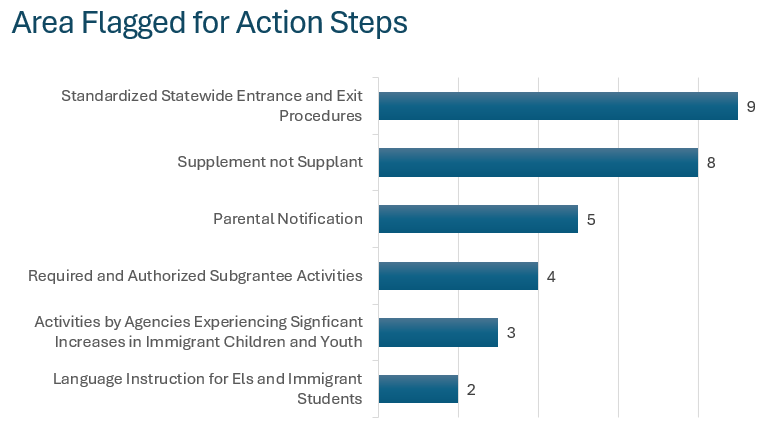
A review of accessible progress monitoring reports for 12 states, spanning FY 2018 to FY 2023, provides a summary of the fiscal and program monitoring indicators and actions that were required for Title III, Part A.
Supplement Not Supplant Requirement
ESEA requires Title III funds be used to supplement the level of federal, state, and local public school funds that would have been made available to English learners. The Education Department identified action steps for eight states (Florida, Maine, New Jersey, New Mexico, Nevada, Ohio, Tennessee, Washington) regarding supplement-not-supplant provisions. Action steps focused on clarifying SEA guidance or strengthening SEA monitoring of LEA uses of Title III to ensure funds were used on supplemental activities rather than mandated activities or activities provided to all students.
Language Instruction: Standardized Statewide Entrance and Exit Procedures
SEAs are required to establish and implement standardized entrance and exit procedures for English learners and monitor LEAs to ensure compliance. The Education Department identified action steps for nine states (Florida, Kentucky, Maine, Montana, New Jersey, New Mexico, Nevada, Ohio, Tennessee) regarding entrance and exit procedures. Common issues were inconsistencies in guidance, offering discretion in entrance and exit procedures rather than a standardized process, and potential over- or under-identification of ELs.
Parental Notification
The Department identified action steps for five states (Tennessee, Ohio, New Mexico, Florida, Maine) regarding parental notification. Issues related to parental notification within the required timeframe, complying with written notification guidelines, and informing parents of the right to opt their child out of Language Instruction Educational Programs or to choose another program or method of instruction, if available.
Monitoring Required and Authorized Subgrantee Activities
The Department identified action steps for three states (Florida, Maine, Tennessee) and a recommendation for another state (New Jersey) regarding monitoring required and authorized subgrantee activities. These ranged from requiring a plan to implement a post-award fiscal monitoring process and ensuring compliance with federal statutes and regulations (Florida), to clarifying LEA eligibility for subgrants (New Jersey, Maine) and clarifying guidance on the non-eligibility of former ELs for Title III funds (Tennessee).
Monitoring Activities by Agencies Experiencing Significant Increases in Immigrant Children and Youth
The Department identified action steps for three states (Nebraska, New Mexico, Maine) regarding monitoring activities by agencies experiencing significant increases in immigrant children and youth. The action steps required states to align their eligibility for Title III funds and their definitions of “immigrant children and youth” with federal policy.
Language Instruction for English Learners and Immigrant Students
SEAs must provide an effective Language Instruction Educational Program (LIEP) and effective professional development and implement other effective activities and strategies that enhance/supplement LIEPs (which must include parent, family, and community engagement activities). While no issues were raised around professional development, the Department identified action steps for New Mexico regarding language instruction, and for Tennessee regarding parent, family, and community engagement.
Government Accountability Office
The Government Accountability Office (GAO) is an independent, non-partisan federal agency that “provides Congress and federal agencies with objective, non-partisan, fact-based information to help the government save money and work more efficiently.”
The GAO’s ongoing monitoring of Title III reveals persistent challenges in ensuring programs effectively serve English learners by improving both English proficiency and academic achievement. Reports emphasize that effective Title III programs should be based on the unique needs of English learners and responsive to student performance data; grounded in rigorous research on proven effective instructional approaches; subject to performance monitoring to make improvements to program implementation and effectiveness; and accompanied by robust implementation plans with measurable goals and clear timelines.
GAO reports focus on proper Title III fund usage, emphasizing that Title III funds cannot be used to fulfill basic civil rights obligations under Title VI and the Equal Educational Opportunities Act. The reports note that funds cannot be used for core language instruction that LEAs are already required to provide by law, and that states must monitor LEAs and provide technical assistance when Title III strategies are not effective.
How does the U.S. Department of Education help states and schools to effectively support English learners?
The U.S. Department of Education supports English learners in myriad ways. Primarily, the Office of English Language Acquisition (OELA) is tasked with supporting states, school districts, and families so that English learners (EL) are served effectively. OELA promotes English proficiency and biliteracy by: informing national policy decisions; administering discretionary grants for EL teacher preparation programs; investing in research and evaluation studies to improve EL student outcomes; and disseminating information about educational research, practices, and policies for ELs. English learners also benefit from the activities of the Institute for Education Sciences (IES), which funds education research, evaluates federal programs, supports evidence-based policy and practice, collects and reports education statistics, and conducts peer reviews to validate research projects and reports. The Office of Civil Rights (OCR) enforces federal civil rights laws in all schools or other entities that receive funding from the Education Department, including Title VI protections for English learners. The hollowing out of these offices within the Education Department will impede advancements in instructional practices for English learners and limit enforcement of their civil rights.
More Detail
Office of English Language Acquisition
The goal of OELA is to provide support and resources for states, school districts, and families so that English learners are served effectively. After the March 2025 dismissal of Education Department employees, the office that was formerly operating with about a dozen staff members was left with only one. OELA was subsequently absorbed into the Office of Elementary and Secondary Education (OESE).
When fully operational, OELA promoted English proficiency and biliteracy by informing national policy decisions, administering discretionary grants for EL teacher preparation programs, investing in research and evaluation studies to improve EL student outcomes, and disseminating information about educational research, practices, and policies for ELs through the National Clearinghouse for English Language Acquisition (NCELA).
OELA has published various resources to help state education agencies and other personnel manage Title III projects and grants. It is also responsible for the biennial report to Congress on the implementation of Title III. Recently, OELA published a Newcomer Tool Kit (2023) to assist educators working with recent immigrants, including asylees and refugees, and an English learner Family Toolkit (2023) to help families navigate the public school system and ensure their rights are being met. Older resources include an English Learner Tool Kit (2015) and a research review of Dual Language programs (2015). NCELA also published numerous two-page fact sheets on various topics for English learners, such as career and technical education, dual language learners in early care, homelessness, and demographic trends.
OELA staff provided significant administrative support, technical assistance, and guidance to ensure that states and local educational agencies were complying with the requirements of formula and discretionary grants. With this staff terminated, school administrators and other grant recipients no longer have access to the experts who provided crucial and substantive information that supported their work.
Institute of Education Sciences
The Institute of Education Sciences (IES) is the independent research, statistics, and evaluation arm of the U.S. Department of Education. IES has published over 150 reports, data files, fact sheets, infographics, FAQs, blog posts, and events specifically for English learners just since 2020. IES performs five main activities:
- Funding education sciences
Through the National Center for Education Research (NCER) and the National Center for Special Education Research (NCSER), IES provides funding opportunities for projects that develop and rigorously test new approaches for improving education outcomes. Steep cuts in IES staff and cancelled contracts mean that ongoing studies related to English learners may never be completed and new grants may not be awarded.
- Evaluating federal programs
IES currently lists 11 evaluation contracts that support English learners, though the state of these contracts is uncertain. For example, the IES website lists as cancelled in February 2025 a $10 million contract for the study of English learner classification policies, despite the study being underway since September 2021. A six-year, $4 million contract to conduct a national evaluation of Title III implementation was cancelled with less than one year of the contract remaining.
- Supporting evidence-based policies and practices
In addition to the funding opportunities described above, IES supports the use of data and research in education decision-making through the What Works Clearinghouse (WWC) and Regional Educational Labs (RELs). The WWC lists 68 publications for English learners from the last decade, categorizing results based on whether they exhibit strong, moderate, or promising evidence or have uncertain effects. There are 10 RELs that collaborate with state departments of education, school districts, and classroom leaders to address pressing problems in education policy and practice. In the last decade, RELs have published over 200 products relating to English learners. In February 2025, the Education Department cancelled 10 REL contracts totaling over $336 million because they were identified as “wasteful and ideologically driven” with plans to enter into new contracts to satisfy statutory requirements. In August, a federal judge ruled that the terminations were illegal and ordered them reinstated.
- Collecting and reporting education statistics
Through the National Center for Education Statistics (NCES), IES collects, analyzes, and reports data on the condition of U.S. education. In addition to annual demographic reporting on the counts of English learners (Common Core of Data), NCES also conducts numerous surveys and assessments relevant to the English learner population, including the National Teacher and Principal Survey, the Early Childhood Longitudinal Study, and the National Assessment of Educational Progress (NAEP). In June 2025, the Education Department missed a statutory deadline, for the first time, for issuing the annual statistical report on the condition of education. The Department subsequently published a sparse report indicating that it would update indicators on a rolling basis. Former staffers blamed the delay on DOGE’s cancellation of contracts and the massive layoffs at NCES.
- Scientific peer review
To comply with the Education Sciences Reform Act (ESRA), all research, statistics, and evaluation reports produced by IES must undergo peer review before publication, coordinated by the Office of Science. Reports that include new analyses of data, systematic reviews, or syntheses of research are sent to external reviewers. Reports using limited descriptive data analyses or already published findings are reviewed internally. The Office of Science is also responsible for the rigorous peer review of grant applications submitted to IES.
Office of Civil Rights
The Office of Civil Rights (OCR) is responsible for enforcing federal civil rights laws in schools and other entities that receive funding from the Education Department. OCR responds to complaints of discrimination, conducts compliance reviews to target resources on problems that appear to be widespread, and provides technical assistance to help institutions voluntarily comply with civil rights laws. OCR is responsible for enforcing English learner’s rights under Title VI of the Civil Rights Act of 1964 (Title VI). OCR also administers the Civil Rights Data Collection (CRDC), a mandatory, biennial collection of district and school level data that is used to enforce civil rights statutes. Notably, most CRDC data are disaggregated by English learner status.
In March, about half of OCR’s 550 employees were laid off and five of the twelve regional offices were abolished, making it “virtually impossible” for the office to resolve complaints and conduct investigations. Multiple ongoing lawsuits are challenging the firings. Court filings submitted in August by the Education Department included a months-long plan to rehire about 250 of the OCR staff fired in March.
Have programs for English learners developed through Title III been successful in achieving the program’s goals?
A review of the research evidence suggests that Title III may be struggling to meet its goals due to implementation challenges and inadequate funding that has not kept pace with the growing English learner (EL) population, but not because of a lack of evidence for what works to support ELs and recent immigrants. This conclusion is based on 500 articles screened for relevance and against inclusion criteria, yielding 23 systematic reviews of empirical studies and 51 original, published empirical studies published between 2015 and 2025. Empirical studies across many disciplines and methodological orientations have yielded a robust literature on programs, practices, and instructional strategies that effectively improve English language proficiency and academic achievement. However, it is not clear that Title III funds are being used to support these practices. While an important piece of the puzzle is missing – a cut contract for an evaluation of Title III might provide more answers – it is clear that schools need more prepared teachers to enact evidence-based approaches; while all states direct at least some Title III funds to better prepare their workforce to support ELs, districts consistently report significant unmet need for prepared EL teachers. Finally, researchers and advocates have consistently argued that Title III funding for English Learners and recent immigrants is inadequate. While estimates of what would be adequate levels of funding vary, our review did not find any research suggesting that there is currently enough or too much money being set aside to support ELs.
View our full research brief, Title III Evidence Review: The Impact of
Federal Support for English Learners.
support our work
As a nonprofit organization, ELC relies on the generous contributions of individuals, corporations and foundations to support our work.
Latest News
join our network
"*" indicates required fields