
Federal Support for Students with Disabilities fAQ
Understanding the U.S. Department of Education’s Role in Supporting Students with Disabilities through IDEA
What is the Individuals with Disabilities Education Act (IDEA)?
First enacted in 1975, IDEA ensures that children with disabilities have access to education and are provided with the specific services needed to benefit from it. The Office of Special Education Programs (OSEP) within the U.S. Department of Education (USED) administers IDEA and monitors the use of funds using its Differentiated Monitoring and Support (DMS) framework.
What are the purposes and goals of IDEA?
The purpose of IDEA is to support the right to a free appropriate public education for students with disabilities in the least restrictive environment. The law is organized into four main parts:
- Part A, General Provisions: Outlines the foundational findings, purposes, and definitions used throughout the act.
- Part B, Assistance for Education of All Children with Disabilities: Authorizes grants to states that address special education and related services for children and youth aged 3 through 21.
- Part C, Infants and Toddlers with Disabilities: Authorizes grants to lead agencies for providing early intervention services for infants and toddlers from birth through age 2 and their families.
- Part D, National Activities to Improve Education of Children with Disabilities: Authorizes discretionary grants to institutions of higher education and other non-profit organizations to support activities aimed at enhancing special education nationwide through state personnel development, technical assistance and dissemination, technology, personnel development, and parent-training and information centers.
For more information, see: U.S. Department of Education, Office of Special Education Programs and GovFacts, Understanding IDEA: A Comprehensive Guide to America’s Special Education Law
What populations have been served by IDEA?
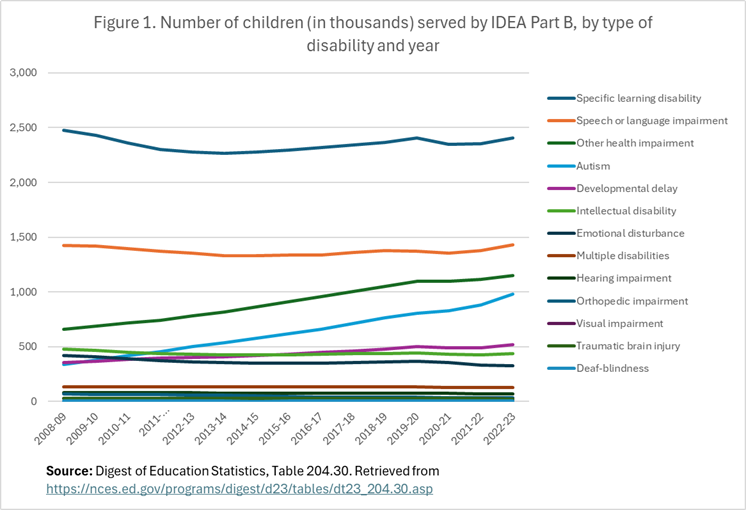
More than 90% of IDEA funds flow through Part B grants. Figure 1 below shows the number of children served by IDEA Part B (in thousands), by disability and by year. As of 2023, the top three categories were specific learning disability, speech or language impairment, and other health impairment.
How have students with disabilities been supported by federal funding?
In Fiscal Year 2024, the federal government provided $14.2 billion to states and districts through IDEA Part B, making it the second-largest source of federal funding for public schools. IDEA operates as a grant statute: the federal government provides funding to states, and states must adhere to specific conditions and procedures outlined in the law to receive these funds.
IDEA provides services to children from birth through age 21:
- Part B serves children and youth with disabilities aged 3 through 21. This is the largest part of IDEA in terms of population served and funding. In the 2022–2023 school year, approximately 7.6 million children received services under Part B, representing over 15% of the public school population nationally.
- Part C serves infants and toddlers with disabilities from birth through age 2, along with their families. In 2022, approximately 406,000 infants and toddlers received early intervention services.
The administration has proposed eliminating several IDEA sub-programs, including the Part B Preschool program in both the FY26 and FY27 budgets. However, the Senate Appropriations Committee rejected most of the administration’s suggested cuts and structural changes to IDEA in FY26. According to the 2024 Fiscal Year Annual Report of the Office for Civil Rights, of the 1.2 million children enrolled in public preschool programs and services, 24% were students with disabilities. IDEA requires all school districts to provide a free appropriate public education to children with disabilities ages 3 through 5.
The Senate bill maintained IDEA funding largely at current levels—about $14.3 billion for Part B state grants, with Preschool (619) and Part C also held steady—and preserved separate Part D programs that the administration had proposed consolidating or eliminating.
What programs and services can IDEA funds be used for, and what can IDEA funds not be used for?
GovFacts outlines allowable expenditures under IDEA Part B and Part C.
Allowable Expenditures under Part B (Ages 3-21)
LEAs can use Part B funds for activities directly related to providing special education and related services:
- Special Education: Specially designed instruction adapted to meet unique needs resulting from a child’s disability
- Related Services such as:
- Speech-language pathology and audiology
- Psychological services
- Physical and occupational therapy
- Social work services
- Counseling services
- School health and nurse services
- Orientation and mobility services
- Personnel Costs: Salaries and benefits for special education teachers, paraprofessionals, therapists, psychologists, and others
- Materials and Supplies: Accessible instructional materials and specialized resources for implementing IEPs
- Assistive Technology: Devices and services that increase, maintain, or improve functional capabilities
- Professional Development: Training for teachers and staff to improve outcomes for students with disabilities
- Evaluations: Costs for determining eligibility and conducting reevaluations
- Early Intervening Services: Up to 15% of funds may support students not identified for special education but needing additional support
Allowable Expenditures under Part C (Birth-2)
Part C funds support early intervention services for infants and toddlers:
- Direct Early Intervention Services: Services identified in a child’s IFSP, such as family training, counseling, home visits, and therapy
- System Components: Activities essential to the statewide system, including identifying eligible infants and toddlers, evaluation procedures, and central coordination
- Payor of Last Resort: Part C funds are generally used only after other available resources (like private insurance or Medicaid) have been accessed
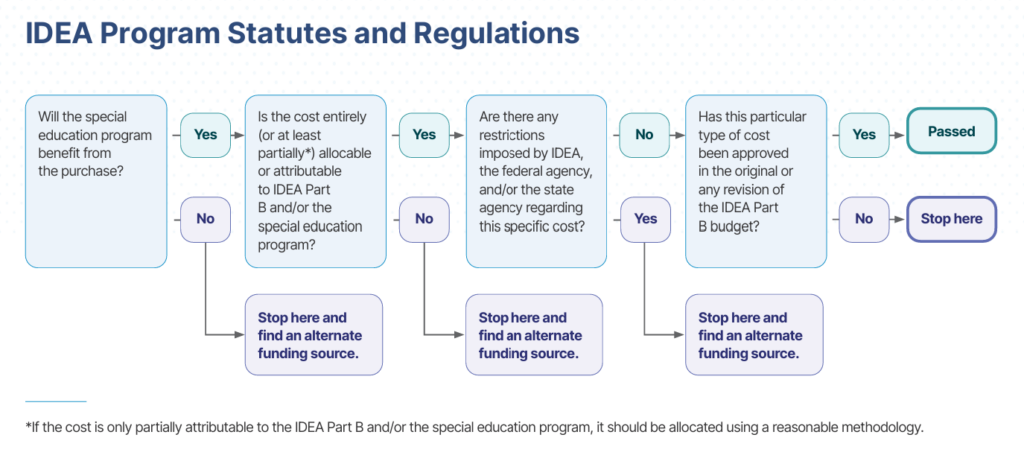
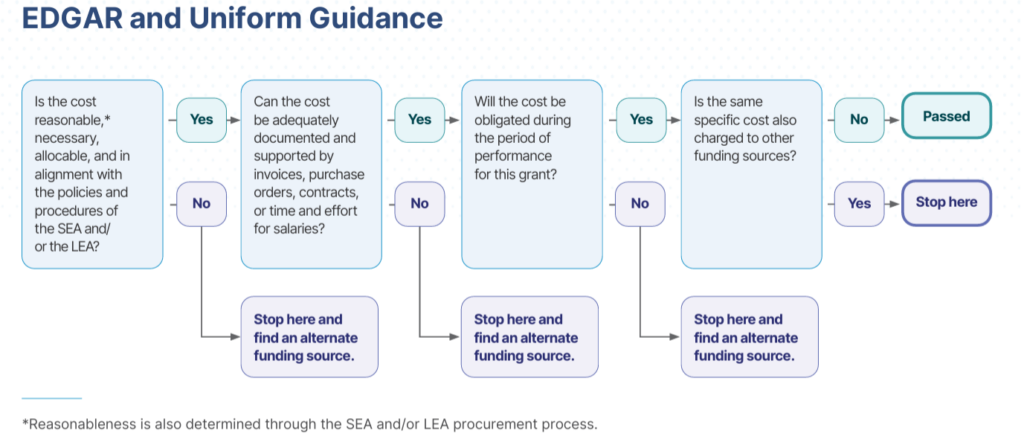
The National Center for Systemic Improvement produced a pair of decision trees for establishing how IDEA Part B funds can be used. State and district agencies can determine if an item can be paid for with IDEA funds by first evaluating it against the “IDEA Program Statutes and Regulations” Decision Tree. If it passes, they would then evaluate allowability using the “EDGAR and Uniform Guidance” Decision Tree. Only items that pass both decision trees are allowable.
What rights do students with disabilities have under federal laws?
The Free Appropriate Public Education (FAPE) provision of IDEA is intended to ensure that all eligible children with disabilities have available to them an education that is:
- Provided at public expense, under public supervision and direction, and without charge;
- Meets the standards established by the State Educational Agency (SEA);
- Includes appropriate preschool, elementary, or secondary education;
- Provided in conformity with an Individualized Education Program (IEP).
Beyond providing access, IDEA aims to protect the rights of both children with disabilities and their parents, assist states and local educational agencies in providing this education, ensure educators and parents have the necessary tools to improve educational results, and assess the effectiveness of these efforts.
In addition to IDEA, several federal laws, described below, are intended to ensure students with disabilities have access to education.
Elementary and Secondary Education Act (ESEA)
The most recent re-authorization of ESEA, the Every Student Succeeds Act (ESSA), returned authority to states and school districts relative to its predecessor, the No Child Left Behind Act. Key provisions related to students with disabilities include challenging state academic standards for all students, and related assessment and accountability requirements that include disaggregation of data for student subgroups. ESSA gives states flexibility in how accountability systems are established. The National Council on Disability (2018) recommended USED officials, peer reviewers, and states maintain inclusion of all students with disabilities in accountability systems, support students with the most significant cognitive disabilities so they have increased access to the general education curriculum, promote the use of evidence-based practices to provide intervention and support to schools and districts identified for improvement, create plans to reduce the use of harsh discipline practices, and include meaningful stakeholder engagement in all aspects of ESSA planning and implementation.
Civil Rights Law
According to USED, the Office for Civil Rights (OCR) works to prevent and address disability discrimination by enforcing two laws that prohibit discrimination based on disability:
- Section 504 of the Rehabilitation Act of 1973 (Section 504), which applies to recipients of Federal financial assistance;
- Title II of the Americans with Disabilities Act of 1990 (Title II), which applies to public entities.
What resources does OSEP provide for families of students with disabilities?
In addition to monitoring use of IDEA funds, funding research, and supporting states and districts to effectively serve students with disabilities, OSEP also provides resources for families of students with disabilities.
The IRIS Center, funded through a cooperative agreement with the USED Office of Special Education Programs (OSEP), is a national center dedicated to improving education outcomes for all children, especially those with disabilities, birth through age 21, through the use of effective evidence-based practices and interventions.
The Center for Parent Information & Resources (CPIR) provides family-friendly information and research-based materials and acts as a “hub” for the network of Parent Centers across the country serving families of children with disabilities. CPIR is funded through OSEP but independently operated by the Statewide Parent Advocacy Network (SPAN).
support our work
As a nonprofit organization, ELC relies on the generous contributions of individuals, corporations and foundations to support our work.
Latest News
join our network
"*" indicates required fields